Barriers#
[1]:
import cityImage as ci
import pandas as pd
import geopandas as gpd
from matplotlib.colors import LinearSegmentedColormap

%matplotlib inline

import warnings
warnings.simplefilter(action="ignore")
[2]:
# initialise path, names, etc.
city_name = 'Paris'
epsg = 27571
crs = 'EPSG:'+str(epsg)
place = 'Paris, Ile-de-France'
Barriers Identification#
Downloading from OSM
Choose between the following methods:
OSMplace, providing an OSM place name (e.g. City).polygon, providing a Polygon (coordinates must be in units of latitude-longitude degrees).distance_from_address, providing a precise address and setting thedistanceparameter.distance_from_point, providing point coordinates (in units of latitude-longitude degrees) and setting thedistanceparameter to build the bounding box around the point.
[3]:
download_method = 'OSMplace'
[4]:
road_barriers = ci.road_barriers(place = place, download_method = download_method, epsg= epsg,
                                 include_primary = True, include_secondary = False)
water_barriers = ci.water_barriers(place = place, download_method = download_method, epsg= epsg)
railway_barriers = ci.railway_barriers(place = place, download_method = download_method, epsg= epsg)
park_barriers = ci.park_barriers(place = place, download_method = download_method, epsg= epsg, min_area = 100000)
C:\Users\gfilo\AppData\Local\miniconda3\envs\cityImage\Lib\site-packages\cityImage\barriers.py:118: FutureWarning: `unary_union` returned None due to all-None GeoSeries. In future, `unary_union` will return 'GEOMETRYCOLLECTION EMPTY' instead.
  sea = sea.unary_union
[5]:
barriers = pd.concat([road_barriers, water_barriers, railway_barriers, park_barriers], ignore_index=True)
barriers.reset_index(inplace = True, drop = True)
barriers['barrierID'] = barriers.index.astype(int)
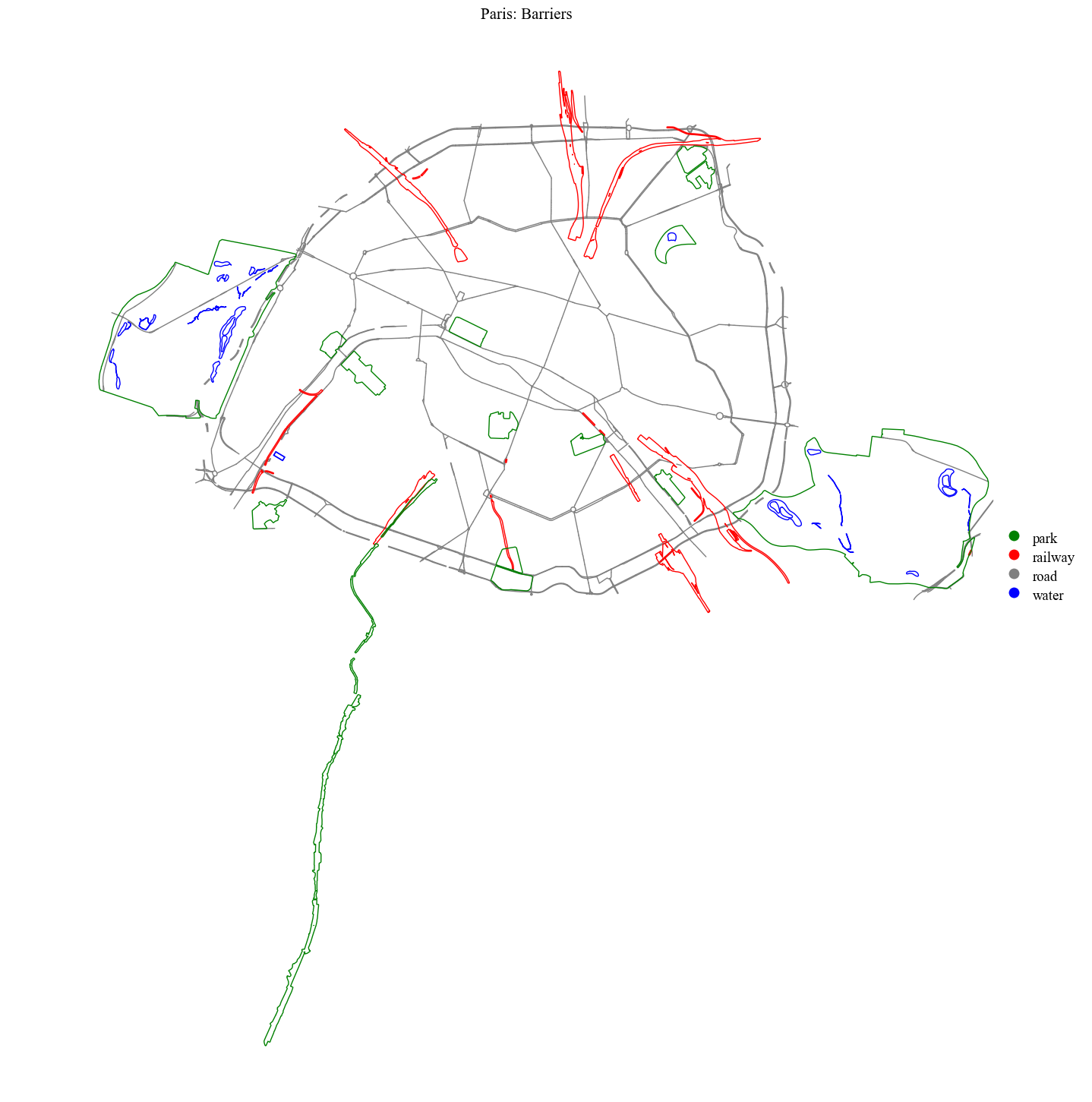
Visualisation
[6]:
barriers.sort_values(by = 'barrier_type', ascending = False, inplace = True)
colors = ['green', 'red', 'gray', 'blue']

cmap = LinearSegmentedColormap.from_list('cmap', colors, N=len(colors))
fig = ci.plot_gdf(gdf = barriers, column = 'barrier_type', black_background = False, title = city_name+': Barriers',
                  legend = True, cmap = cmap)
Incorporating Barriers into the Street Network#
This is an optional step that allows modelling the effect of barriers on pedestrian movement, for exmaple, in agent-based modelling, or in route-choice modelling.
Download the street network
Choose between the following methods:
OSMplace, providing an OSM place name (e.g. City).polygon, providing a Polygon (coordinates must be in units of latitude-longitude degrees).distance_from_address, providing a precise address and setting thedistanceparameter.distance_from_point, providing point coordinates (in units of latitude-longitude degrees) and setting thedistanceparameter to build the bounding box around the point.
Downloading the graph and cleaning it (see the notebook 01-Nodes_Paths_fromOSM for details on the cleaning process)
[7]:
nodes_graph, edges_graph = ci.get_network_fromOSM(place = place, download_method = download_method, network_type = 'walk',
                                                  epsg = epsg)
nodes_graph, edges_graph = ci.clean_network(nodes_graph, edges_graph, dead_ends = True, remove_islands = True,
                            self_loops = True, same_vertexes_edges = True)
C:\Users\gfilo\AppData\Local\miniconda3\envs\cityImage\Lib\site-packages\cityImage\clean.py:417: FutureWarning: the convert_dtype parameter is deprecated and will be removed in a future version.  Do ``ser.astype(object).apply()`` instead if you want ``convert_dtype=False``.
  edges_gdf['tmp'] = edges_gdf['coords'].apply(tuple, 1)
C:\Users\gfilo\AppData\Local\miniconda3\envs\cityImage\Lib\site-packages\cityImage\clean.py:417: FutureWarning: the convert_dtype parameter is deprecated and will be removed in a future version.  Do ``ser.astype(object).apply()`` instead if you want ``convert_dtype=False``.
  edges_gdf['tmp'] = edges_gdf['coords'].apply(tuple, 1)
C:\Users\gfilo\AppData\Local\miniconda3\envs\cityImage\Lib\site-packages\cityImage\clean.py:417: FutureWarning: the convert_dtype parameter is deprecated and will be removed in a future version.  Do ``ser.astype(object).apply()`` instead if you want ``convert_dtype=False``.
  edges_gdf['tmp'] = edges_gdf['coords'].apply(tuple, 1)
C:\Users\gfilo\AppData\Local\miniconda3\envs\cityImage\Lib\site-packages\cityImage\clean.py:417: FutureWarning: the convert_dtype parameter is deprecated and will be removed in a future version.  Do ``ser.astype(object).apply()`` instead if you want ``convert_dtype=False``.
  edges_gdf['tmp'] = edges_gdf['coords'].apply(tuple, 1)
C:\Users\gfilo\AppData\Local\miniconda3\envs\cityImage\Lib\site-packages\cityImage\clean.py:417: FutureWarning: the convert_dtype parameter is deprecated and will be removed in a future version.  Do ``ser.astype(object).apply()`` instead if you want ``convert_dtype=False``.
  edges_gdf['tmp'] = edges_gdf['coords'].apply(tuple, 1)
C:\Users\gfilo\AppData\Local\miniconda3\envs\cityImage\Lib\site-packages\cityImage\clean.py:417: FutureWarning: the convert_dtype parameter is deprecated and will be removed in a future version.  Do ``ser.astype(object).apply()`` instead if you want ``convert_dtype=False``.
  edges_gdf['tmp'] = edges_gdf['coords'].apply(tuple, 1)
C:\Users\gfilo\AppData\Local\miniconda3\envs\cityImage\Lib\site-packages\cityImage\clean.py:417: FutureWarning: the convert_dtype parameter is deprecated and will be removed in a future version.  Do ``ser.astype(object).apply()`` instead if you want ``convert_dtype=False``.
  edges_gdf['tmp'] = edges_gdf['coords'].apply(tuple, 1)
(or) Load it from local path
[3]:
input_path = '../data/'+city_name
nodes_graph = gpd.read_file(input_path+'_nodes.gpkg')
edges_graph = gpd.read_file(input_path+'_edges.gpkg')

nodes_graph.index, edges_graph.index  = nodes_graph.nodeID, edges_graph.edgeID
nodes_graph.index.name, edges_graph.index.name  = None, None
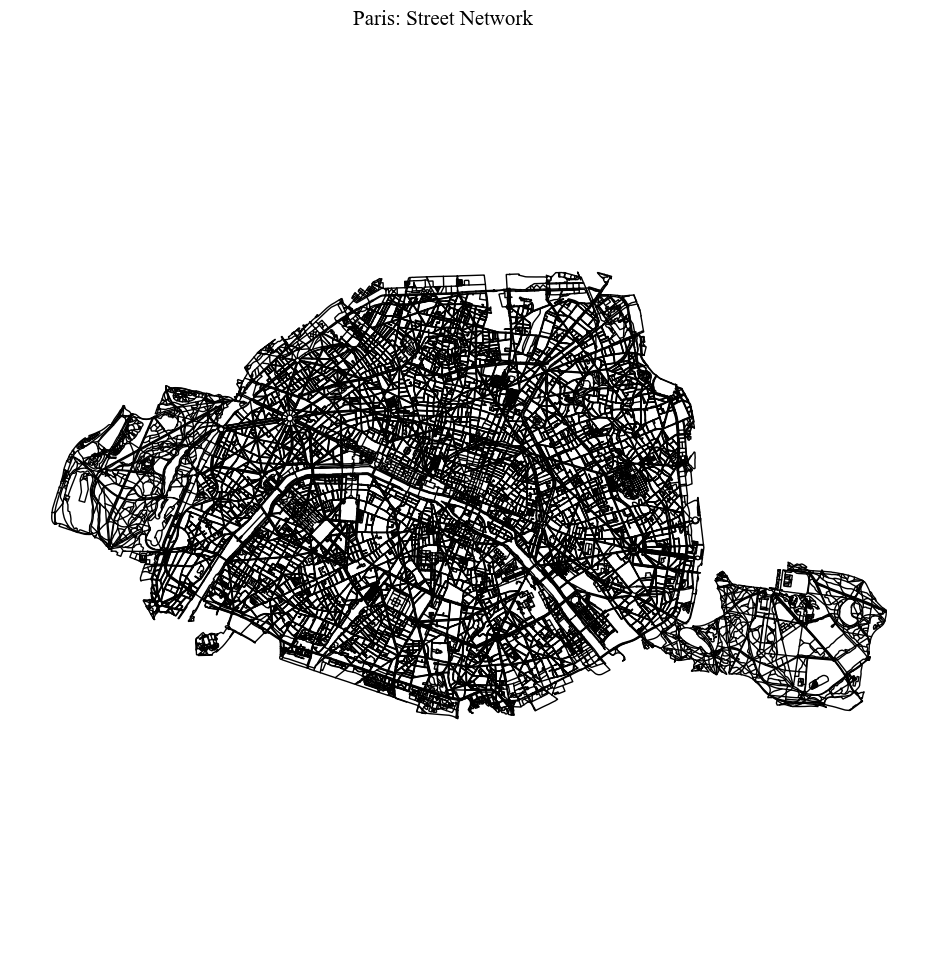
Visualisation
[8]:
fig = ci.plot_gdf(edges_graph, black_background = False, geometry_size = 1.0, alpha = 1.0,
                 color = 'black', title = city_name+': Street Network', figsize = (10,10))
Assigning barriers to street segments#
Type of Barriers:
Positive barriers, from a pedestrian perspective: Waterbodies, Parks.
Negative barriers, from a pedestrian perspective: Major Roads, Railway Structures.
Structuring barriers - Barriers which structure and shape the image of the city: Waterbodies, Major roads, Railways.
[9]:
# clipping barriers to case study area
envelope = edges_graph.unary_union.envelope
barriers_within = barriers[barriers.intersects(edges_graph.unary_union.envelope)]
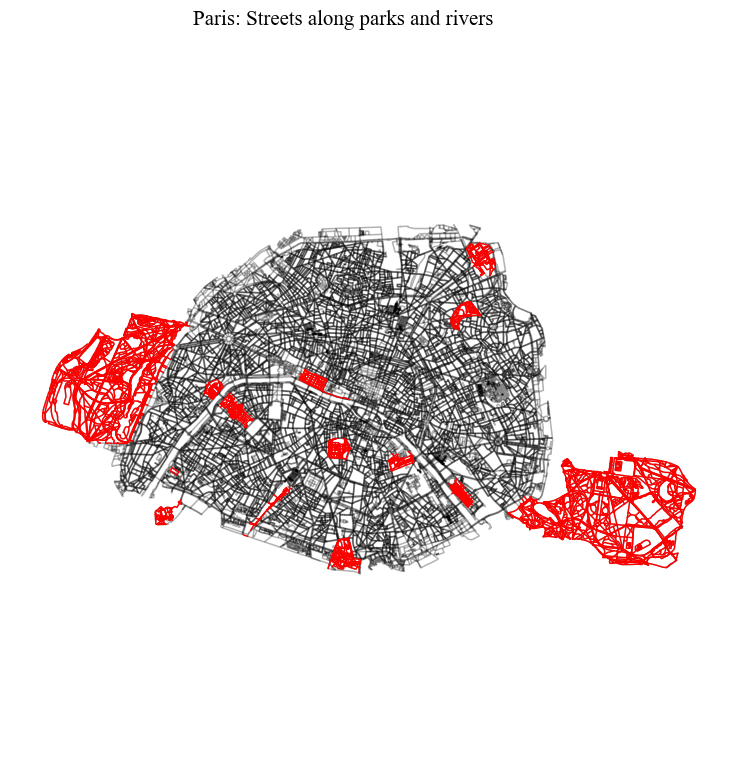
Street Segments Along and Within Positive Barriers#
[12]:
sindex = edges_graph.sindex
# rivers
edges_graph = ci.along_water(edges_graph, barriers_within)
# parks
edges_graph = ci.along_within_parks(edges_graph, barriers_within)
# altogheter
edges_graph['p_barr'] = edges_graph['a_rivers']+edges_graph['w_parks']
edges_graph['p_barr'] = edges_graph.apply(lambda row: list(set(row['p_barr'])), axis = 1)
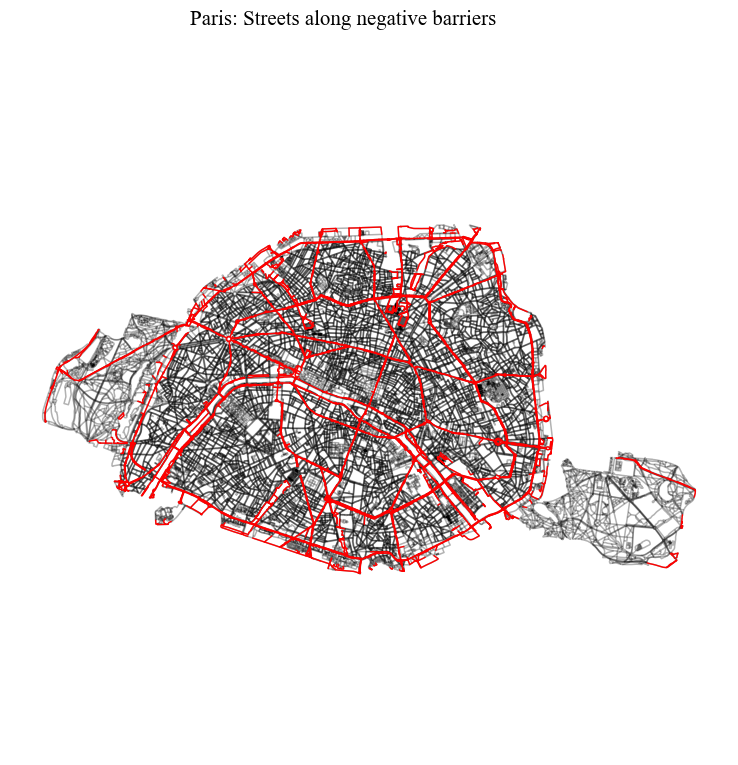
Street Segments Along Negative Barriers#
[15]:
tmp = barriers_within[barriers_within['barrier_type'].isin(['railway', 'road'])]
edges_graph['n_barr'] = edges_graph.apply(lambda row: ci.barriers_along(row['edgeID'], edges_graph, tmp, sindex,
                                            offset = 25), axis = 1)
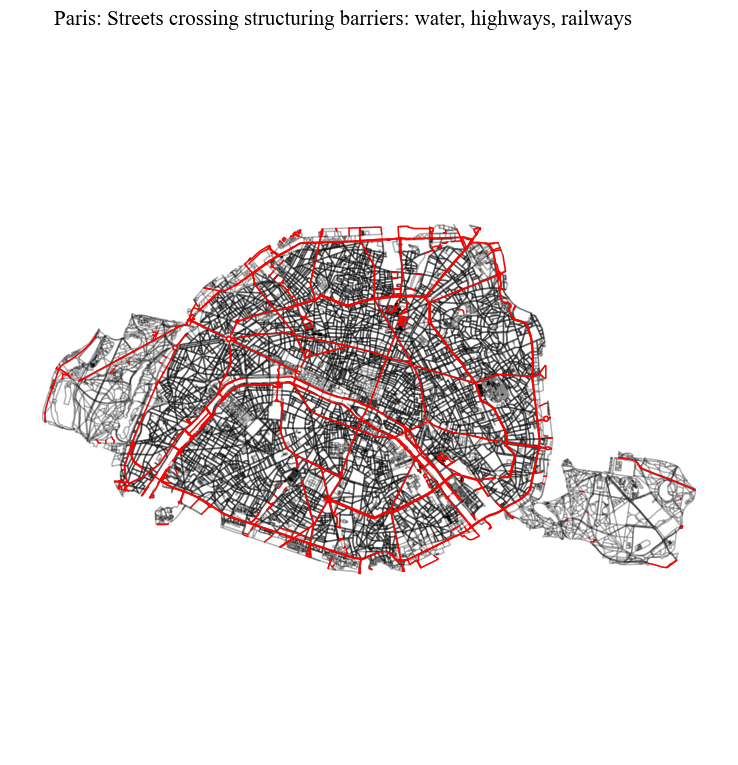
Street Segments Crossing any kind of barrier but parks: Structuring Barriers#
[16]:
edges_graph = ci.assign_structuring_barriers(edges_graph, barriers_within)
Visualisation
[20]:
# positive barriers
edges_graph['p_bool'] = edges_graph.apply(lambda row: True if len(row['p_barr']) > 0 else False, axis = 1)
tmp = edges_graph[edges_graph.p_bool == True].copy()

# base map
base_map_dict = {'base_map_gdf': edges_graph, 'base_map_alpha' : 0.3, 'base_map_color' : 'black'}
fig = ci.plot_gdf(tmp, black_background = False, figsize = (8, 8), color = 'red', title = city_name+': Streets along parks and rivers',
              legend = False, **base_map_dict)
[22]:
# negative barriers
edges_graph['n_bool'] = edges_graph.apply(lambda row: True if len(row['n_barr']) > 0 else False, axis = 1)
tmp = edges_graph[edges_graph.n_bool == True].copy()

# base map
fig = ci.plot_gdf(tmp, black_background = False, figsize = (8, 8), color = 'red', title = city_name+': Streets along negative barriers',
              legend = False, **base_map_dict)
[23]:
# separating barriers
tmp = edges_graph[edges_graph.sep_barr == True].copy()
ci.plot_gdf(tmp, black_background = False, figsize = (8, 8),  color = 'red',
            title = city_name+': Streets crossing structuring barriers: water, highways, railways',
             **base_map_dict)
[23]:
Exporting
[32]:
# saving barriers_gdf
output_path = '../output/'+city_name
barriers.to_file(output_path+"_barriers.gpkg", driver='GPKG')

# converting list fields to string
to_convert = ['a_rivers', 'w_parks','n_barr', 'p_barr']
edges_graph_string = edges_graph.copy()
for column in to_convert:
    edges_graph_string[column] = edges_graph_string[column].astype(str)

edges_graph_string.to_file(output_path+"_edges_ped.gpkg", driver='GPKG')
nodes_graph.to_file(output_path+'_nodes_ped.gpkg', driver='GPKG')